One fixed program — 112 days of strength, power, and conditioning. The app shows you each day's session, logs what you lift, times your rest, and re-tests you on three benchmark days so you can see whether it worked. No account. Works offline; your data stays on the phone.
There is one program in here and you can’t change it. Five training days a week, two recovery days, sixteen weeks. If you want a workout builder, this isn’t it. If you want to be handed the day’s work and keep an honest record of what you did, it is.
Five training days and two recovery days, every week.
Strength Monday, Tuesday & Saturday. Power Wednesday. Conditioning Friday.
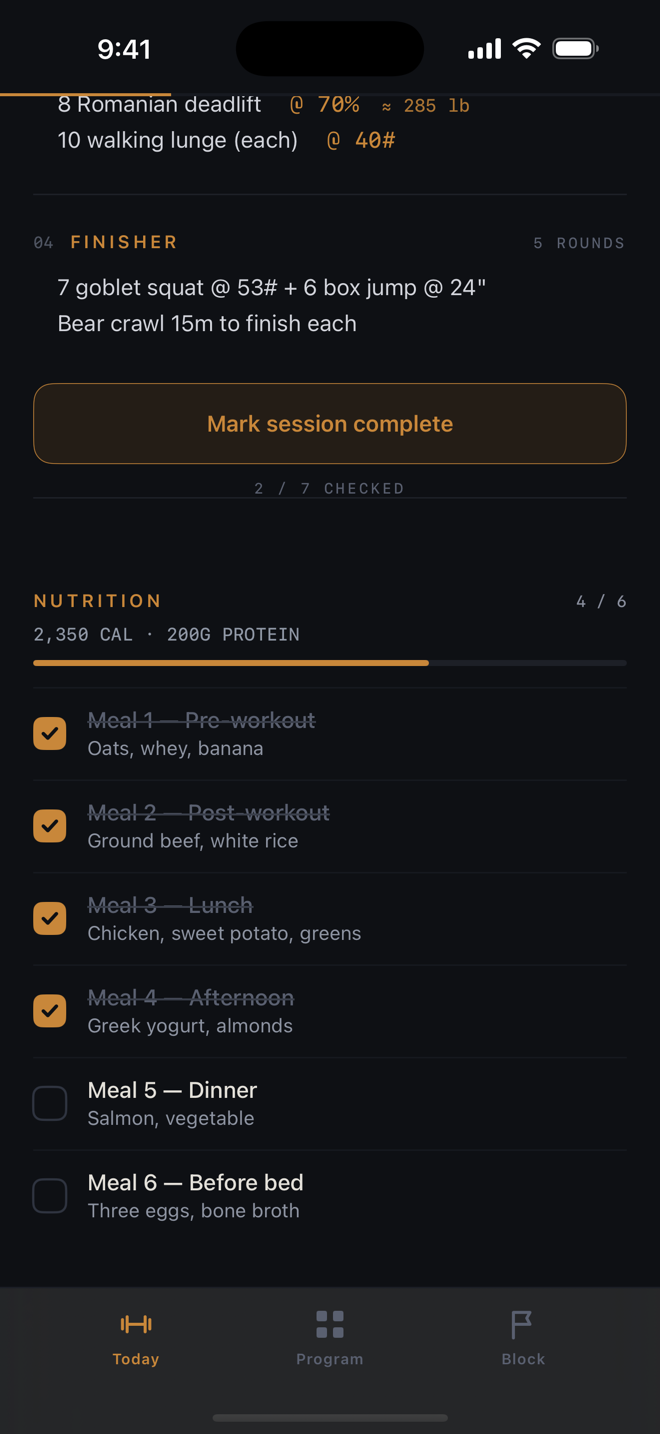
Checked off like sets — protein-first, scaled to your body weight. No macro counting.
Dashed items appear in a handful of sessions. In short: a CrossFit-style or well-equipped garage gym covers everything — the rower and air bike aren't optional, both are benchmark tests.
The week keeps the same shape for all sixteen weeks — you always know what kind of day it is. The sessions inside it never repeat: the content changes every week and the loads climb block by block. Only the benchmark comes back, so the comparison means something.
Moderate weights, clean reps. Four weeks to get your technique consistent on the main lifts and your body used to training five days a week — before the weights get heavy. Nothing heroic.
The weights go up and the rests get shorter. Top sets climb week over week, the intervals get harder, and you should be eating more to keep up. This is where most of the strength is built.
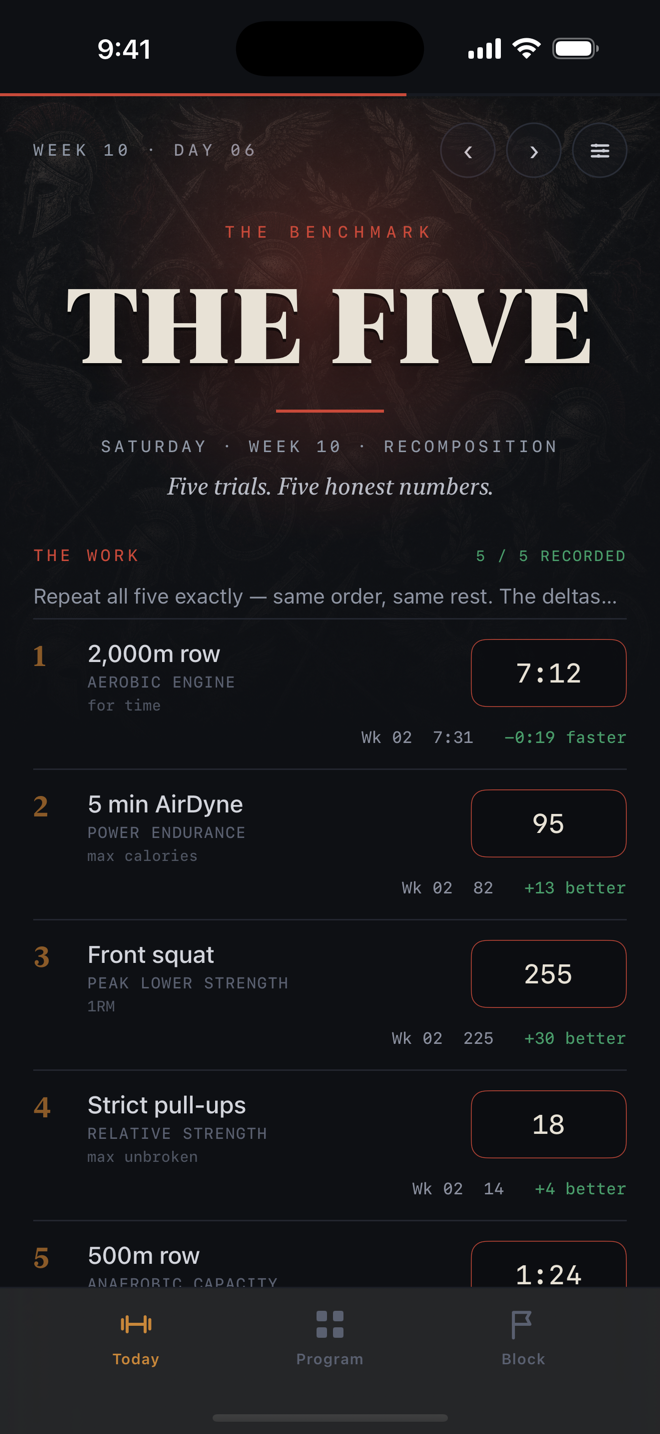
Keep the strength you built while dropping fat: nutrition tightens, conditioning volume rises, and the heavy lifts stay in to protect your numbers. Week 10 re-tests The Five against your week-2 baseline.
The heaviest weights of the program at lower volume, with more recovery between sessions, then a final deload. Week 15 re-tests The Five — the last read on what sixteen weeks changed.
Five tests. You do them in week two, again in week ten, and again in week fifteen — and the app shows the change against your last numbers. The program doesn’t end with a feeling; it ends with a comparison.
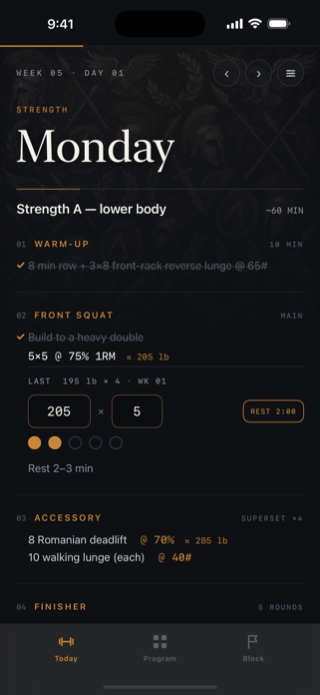
The full benchmark →The program is anchored to your start date, so the app opens on the day you’re on. The session is written out block by block — warm-up, main lift, accessories, conditioning — with the day’s six meals below it. There’s an optional morning notification.
Tap a line to check it off. On the main lifts, tick off each set and enter the weight and reps you actually did. What you lifted last time is shown next to the entry, so you know what to load.
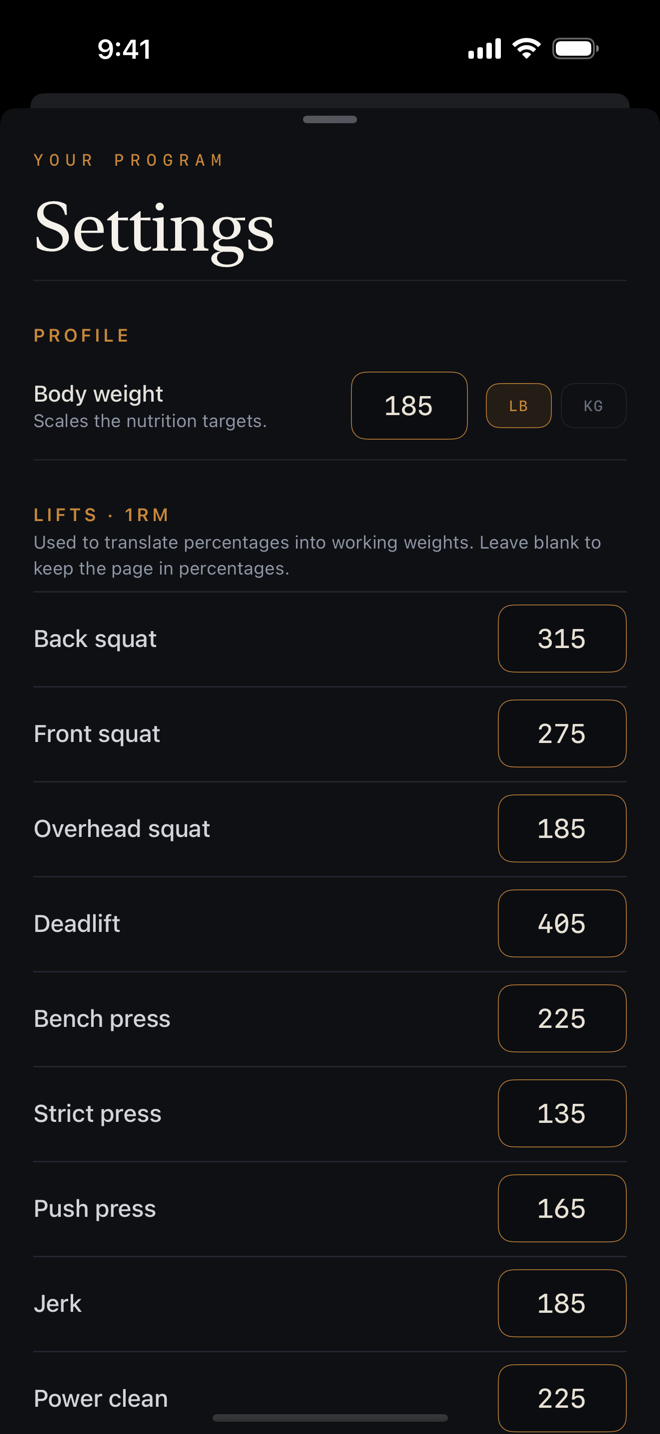
Enter your one-rep maxes and a prescription like “5×5 @ 75%” shows the actual bar weight next to it, in pounds or kilograms. If you don’t enter them, you just see the percentages.
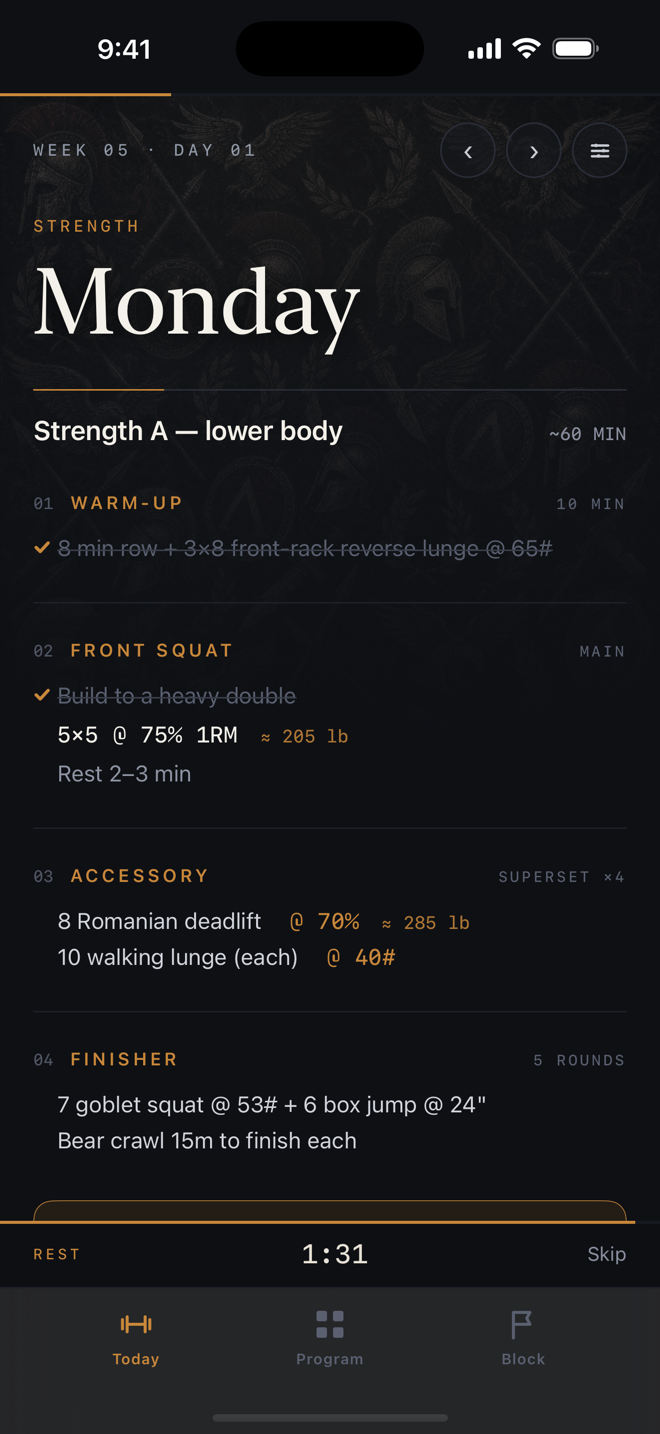
When the program prescribes rest, finishing a set starts the countdown. It sits above the tab bar and stays visible wherever you scroll. There’s a skip button. That’s the whole feature.
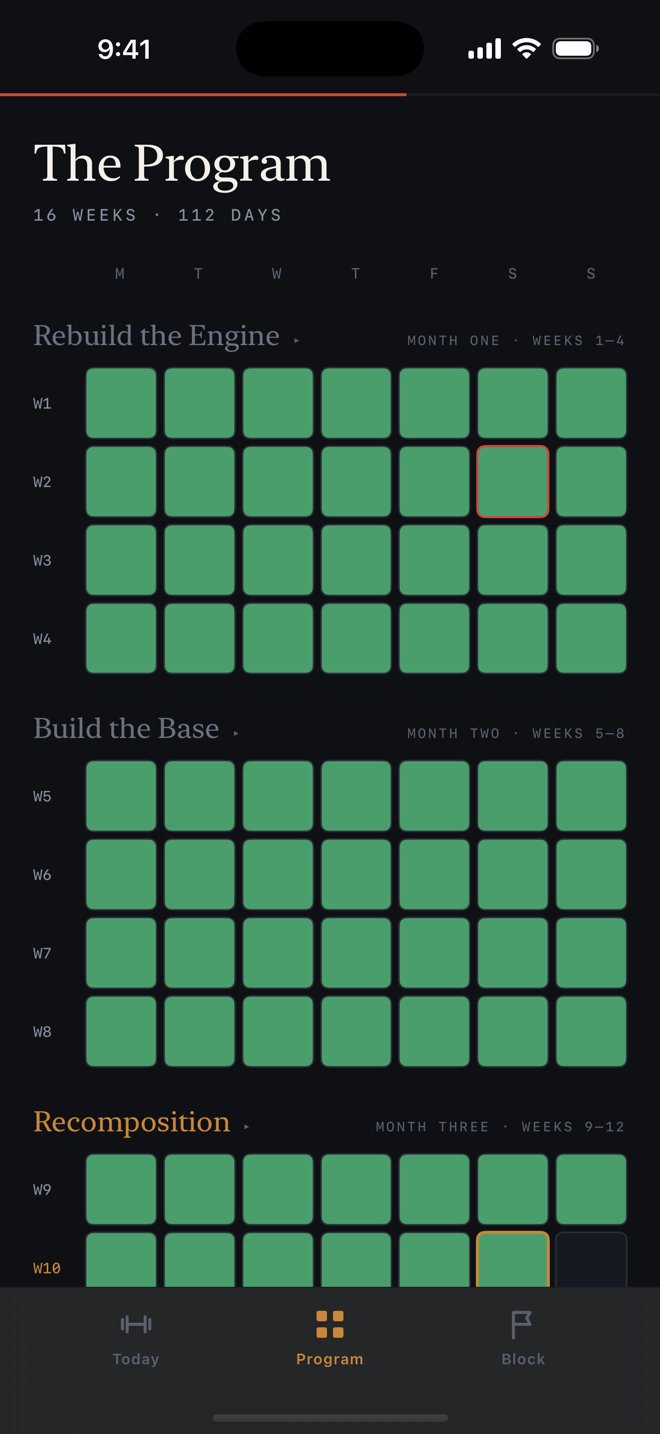
A calendar of all 112 days in four blocks. Days fill in as you complete them. If you fall behind, the app counts the unlogged sessions and lets you go back and fill them in — or restart the schedule from today.
There is no login and no server. The program, your logs, and your numbers live on the phone and nowhere else — the app works the same in a basement gym with no signal.
The program is fixed, the logbook is built in, and the first session is written. Sixteen weeks later, The Five tells you what changed.
Questions or trouble? The app works offline and keeps your data on your phone — [email protected] and we'll help.