Fit for Sparta
The benchmark

THE FIVE

Five tests measure what sixteen weeks of Fit for Sparta actually changed. You set a baseline in week 2, re-test in week 10, and re-test again in week 15. The app records every result and shows the change — faster, slower, better — against your last numbers.

Wk 02 — baseline Wk 10 — re-test Wk 15 — final
The order
Fixed — always I through V
so every re-test is comparable
The rest
10–15 min between tests
full recovery, same each time
The day
~90 minutes, all five
a Saturday session
When
Weeks 2, 10, and 15
baseline, mid-point, final

One rule above all: don't train the tests. The program trains them for you — strength days move the squat and the pull-ups, intervals move the bike, conditioning moves the rows. Test day is for finding out whether it worked, on the same equipment, in the same order, every time.

The five tests
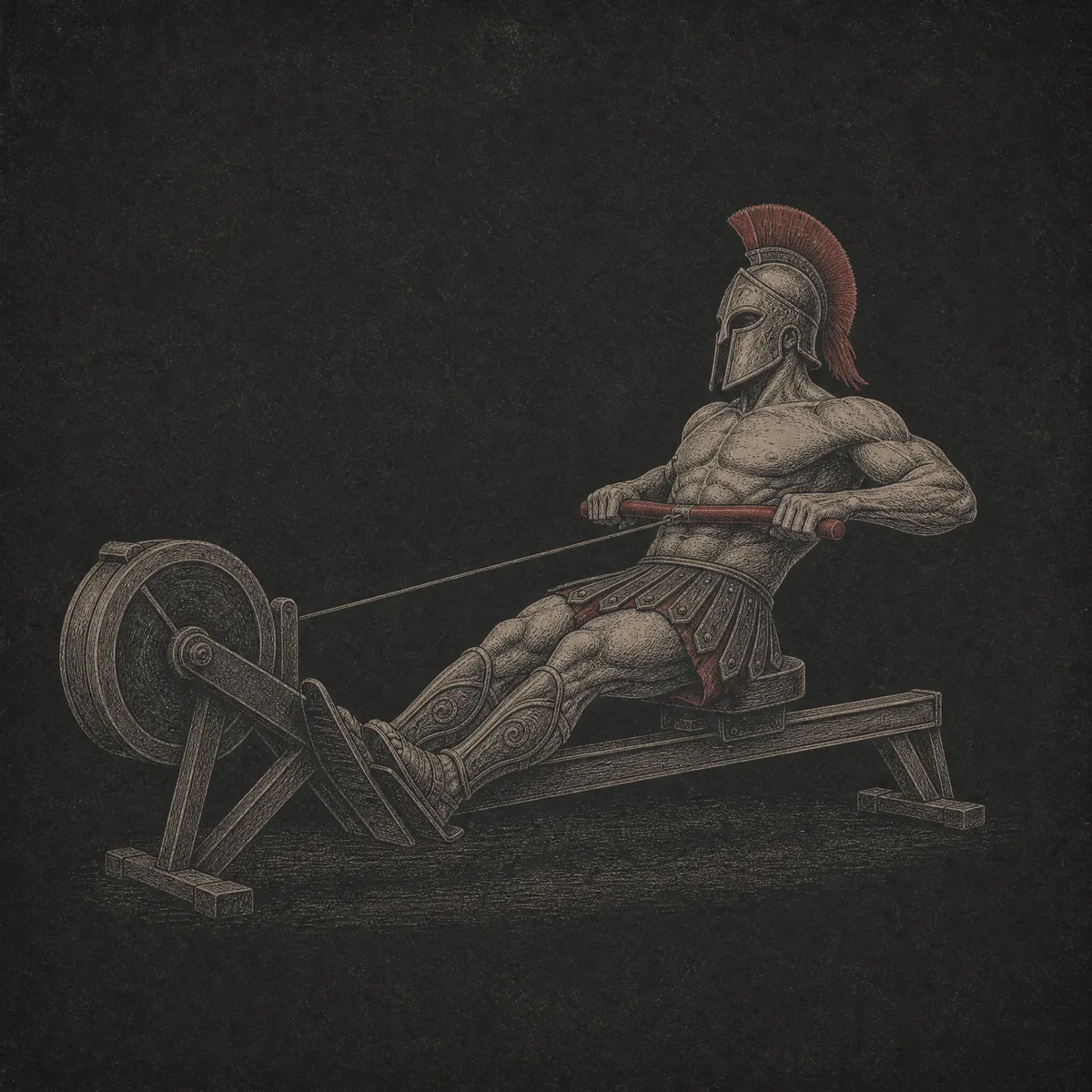
Engraved illustration of a Spartan warrior at the finish of a rowing stroke, leaned back with the handle at his chest
Fig. I — 2,000 m row for time
Aerobic engine

2,000 m row

Row 2,000 meters on the erg, for time. Use the same damper setting every test.

Why it's measured

The 2k is the standard test of aerobic capacity under load: long enough that you can't muscle through it, short enough that you can't hide. Your pace over seven-plus minutes is a direct read on the engine the Friday conditioning builds.

What to expect

Most people land between 7 and 9 minutes. Go out at a pace you believe, hold it through the middle thousand — that's where the test is decided — and empty what's left over the final 500. If the last minute isn't ugly, you paced too soft.
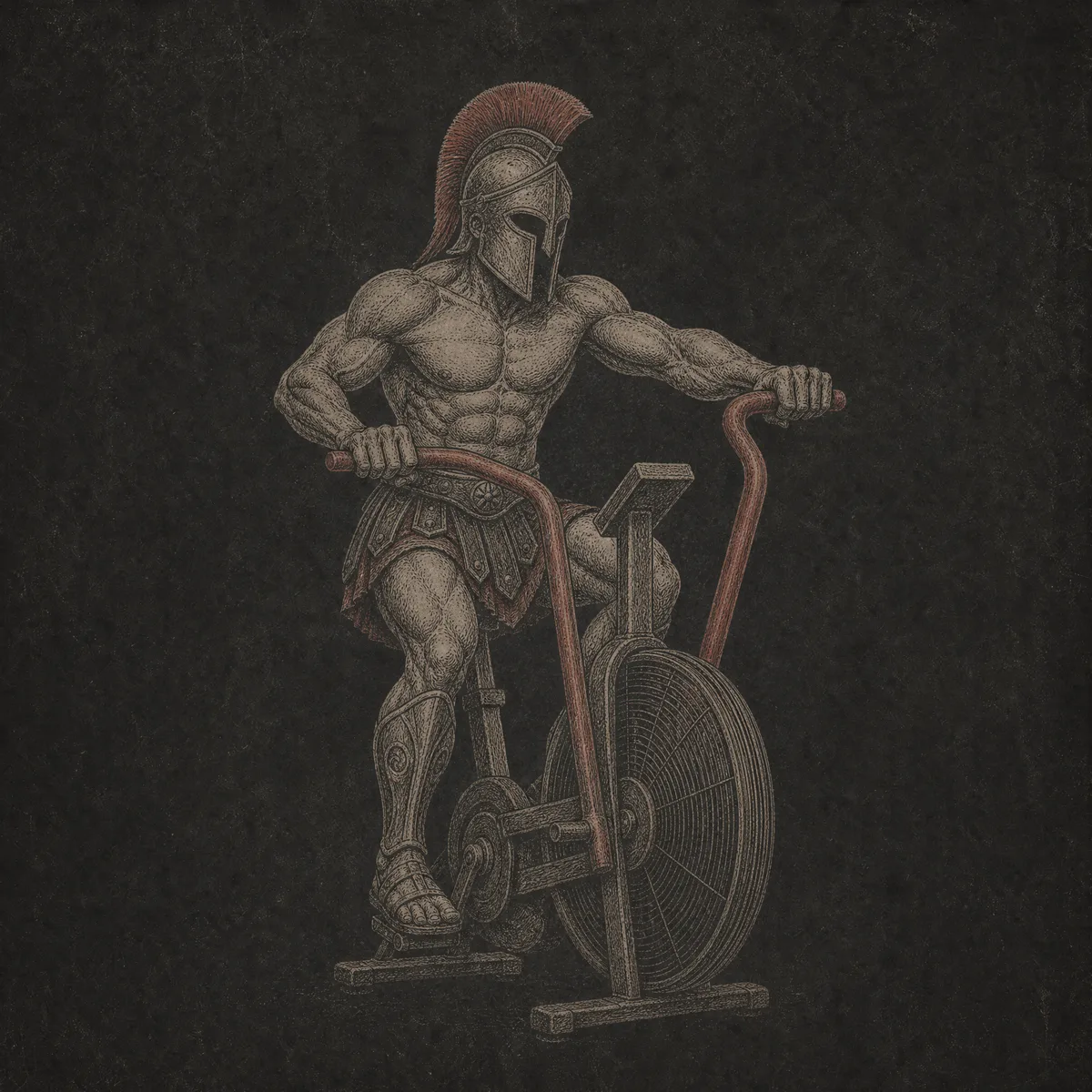
Engraved illustration of a Spartan warrior riding an air bike, hands on the moving arms
Fig. II — AirDyne, five minutes max calories
Power endurance

AirDyne, five minutes

Five minutes on an air bike for maximum calories. Sit down, stay down, pedal the entire five.

Why it's measured

Fan resistance is honest — every drop in effort shows up instantly as fewer calories. Five minutes sits in the gap between a sprint and a grind, so it measures your ability to hold high power while breathing at your ceiling.

What to expect

The first minute feels generous. Minute three is the actual test. Pick an output you can hold for four minutes and spend whatever is left at the end — a fast start you can't hold costs more calories than it buys.

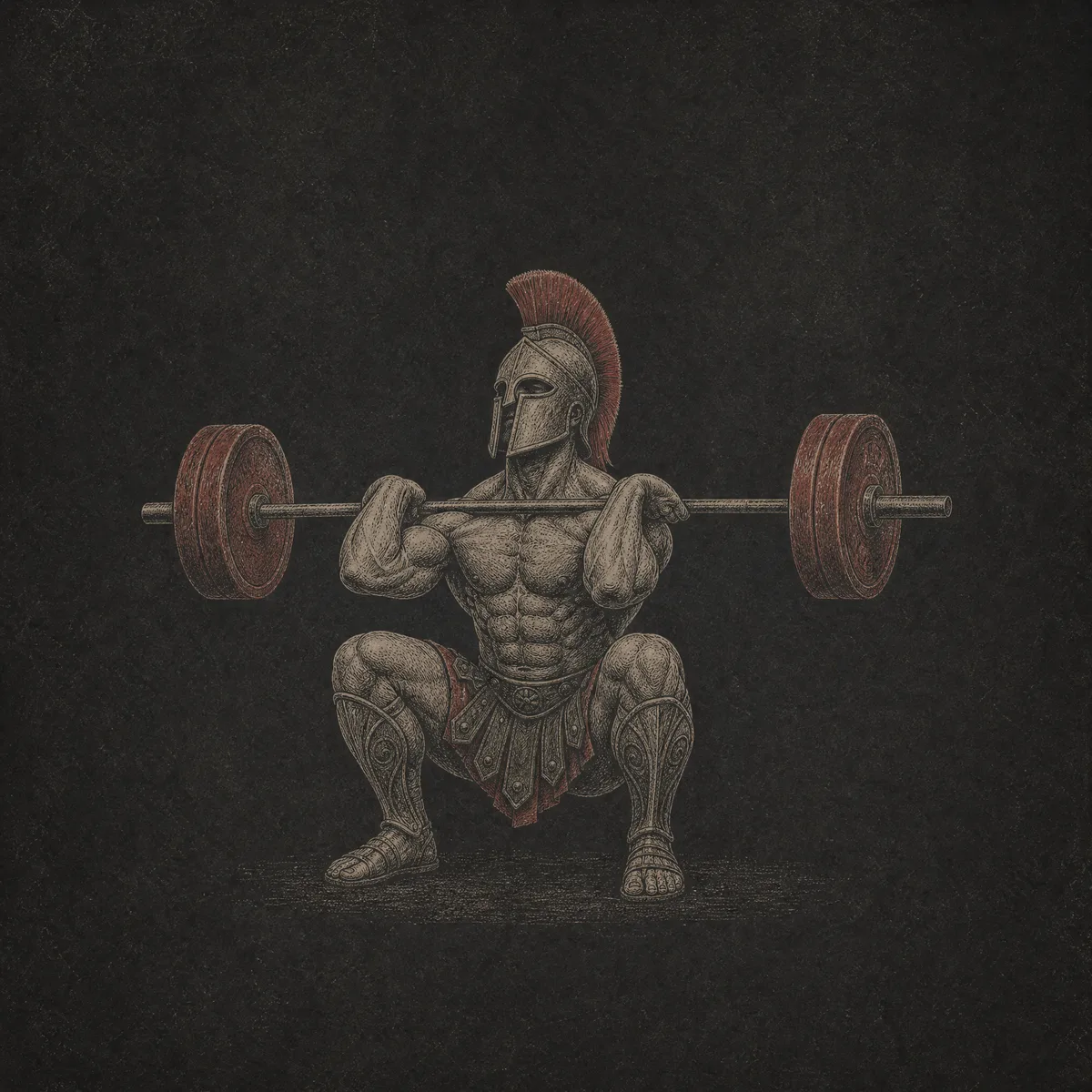
Engraved illustration of a Spartan warrior at the bottom of a front squat, barbell racked across his shoulders
Fig. III — Front squat 1RM
Peak lower strength

Front squat

Work up to the heaviest single front squat you can stand up with clean form — three to five real attempts past your warm-up, with full rest between.

Why it's measured

The front rack doesn't negotiate: lose your trunk and the bar goes down. That makes the front squat a more honest read of usable lower-body strength than a grinding back squat — and it's the max the program's squat percentages hang from.

What to expect

Build in singles — roughly 50, 70, 80, and 90% before real attempts. Count the last clean rep, not the first miss. In week 2, stay conservative: the baseline only has to be honest. The program will move it.

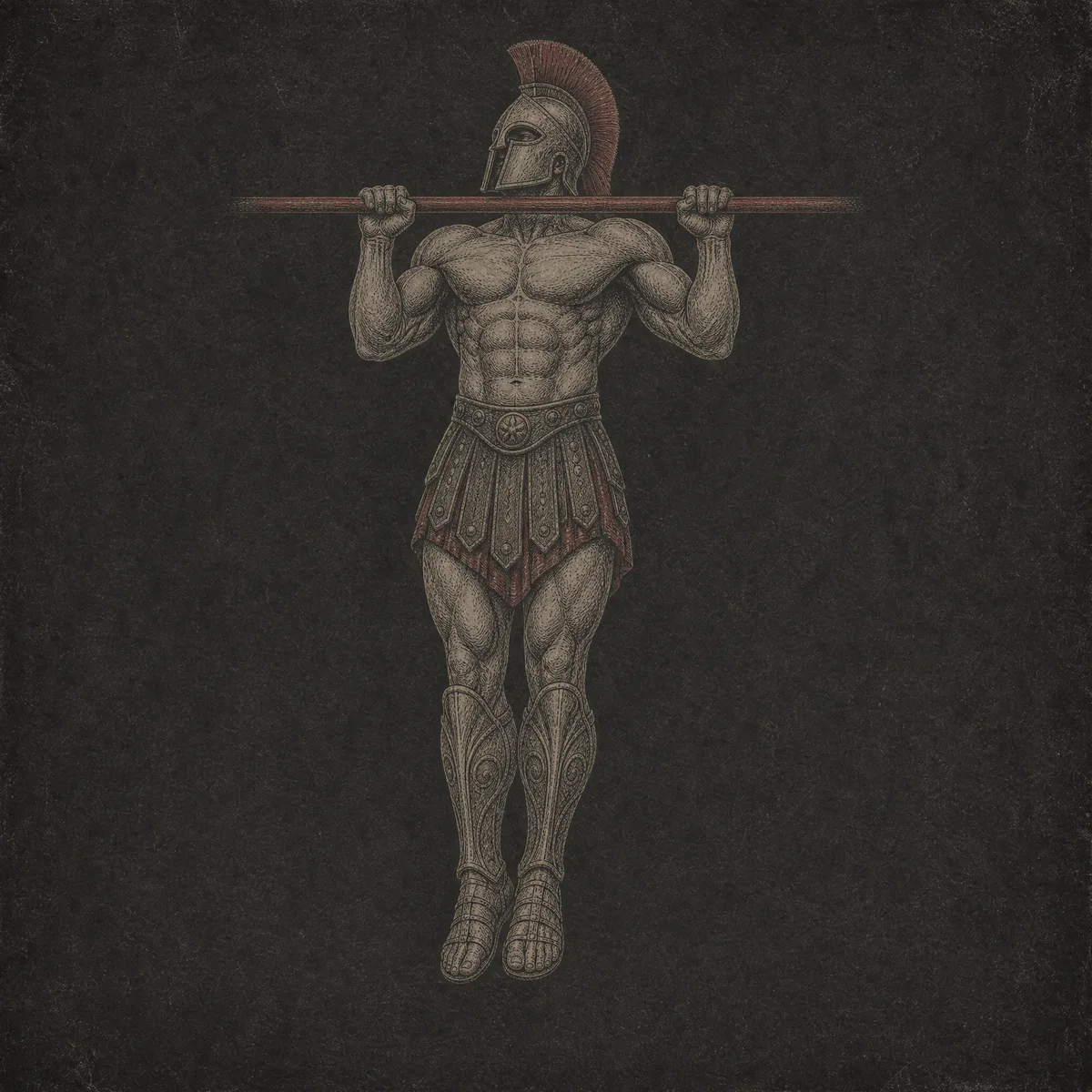
Engraved illustration of a Spartan warrior at the top of a strict pull-up, chin over the bar
Fig. IV — Strict pull-ups max unbroken
Relative strength

Strict pull-ups

One unbroken set of strict pull-ups: dead-hang start, chin clearly over the bar, no kip, no swing. The set ends when you stall or come off the bar.

Why it's measured

Pull-ups measure strength against your own body weight, which makes them the recomposition test in miniature: get stronger or get leaner and the number rises. Do both and it jumps. No other test here responds to nutrition as directly.

What to expect

Whatever your week-2 number is, this is usually the fastest mover on the list across sixteen weeks. Full reps only — a half rep that becomes a real rep later reads as no progress when you actually made plenty.

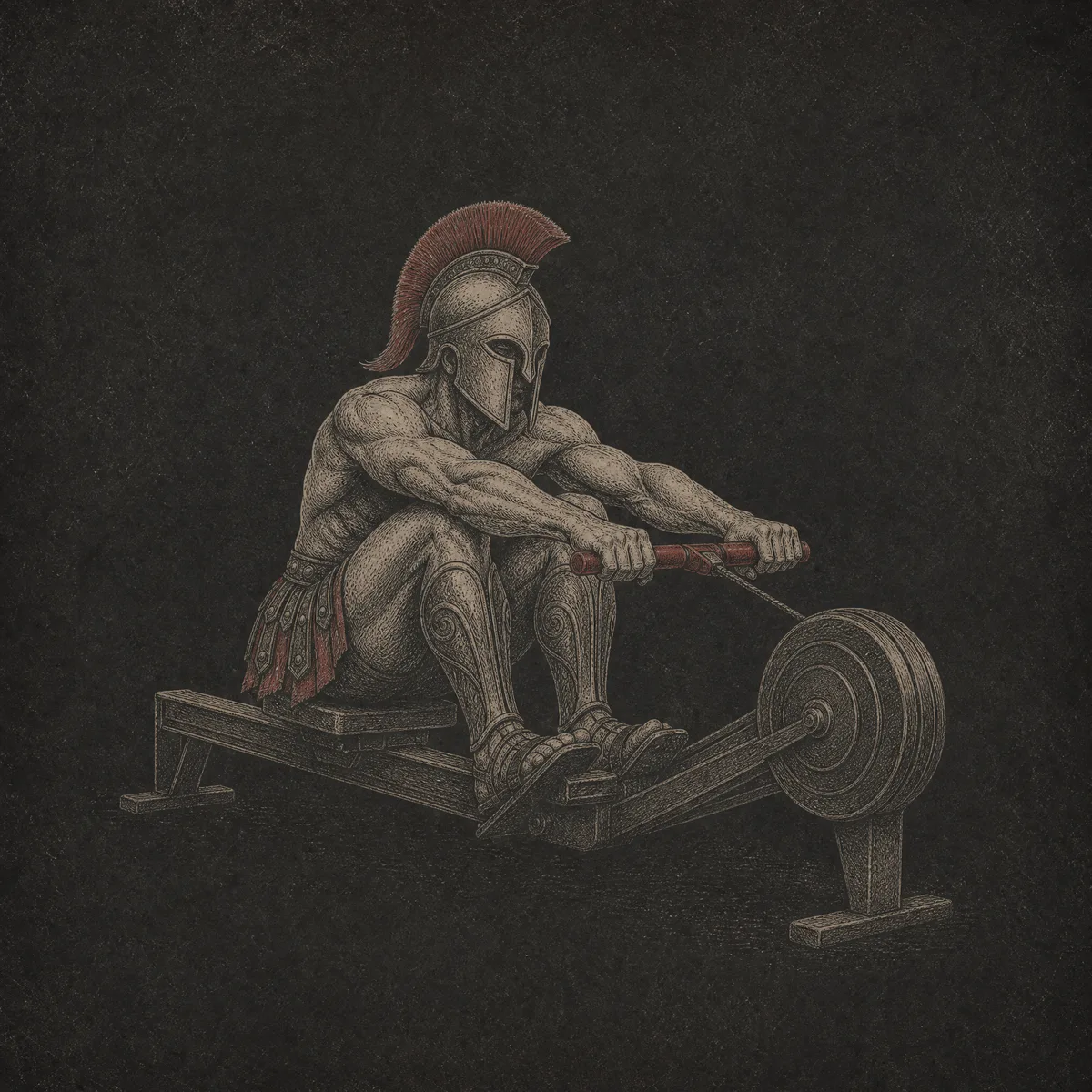
Engraved illustration of a Spartan warrior compressed at the catch of a rowing stroke, ready to drive
Fig. V — 500 m row for time
Anaerobic capacity

500 m row

Row 500 meters, all out, for time. It goes last — nothing useful happens after it.

Why it's measured

The 500 strips pacing out of the equation: raw output on legs that are already taxed. Paired with the 2,000m it brackets your engine from both ends — sustained capacity at one end, violent capacity at the other.

What to expect

Roughly 90 seconds of real discomfort. Go out hard, but the row is won or lost in the final 150 meters, when the flywheel wants to die. Expect wobbly legs afterward. This is why it goes last.

Reading the deltas

Week 2 is a baseline, not a performance.

Set numbers you're sure of — the app reads every later result against the test before it, so an inflated baseline only steals from your week-10 deltas.

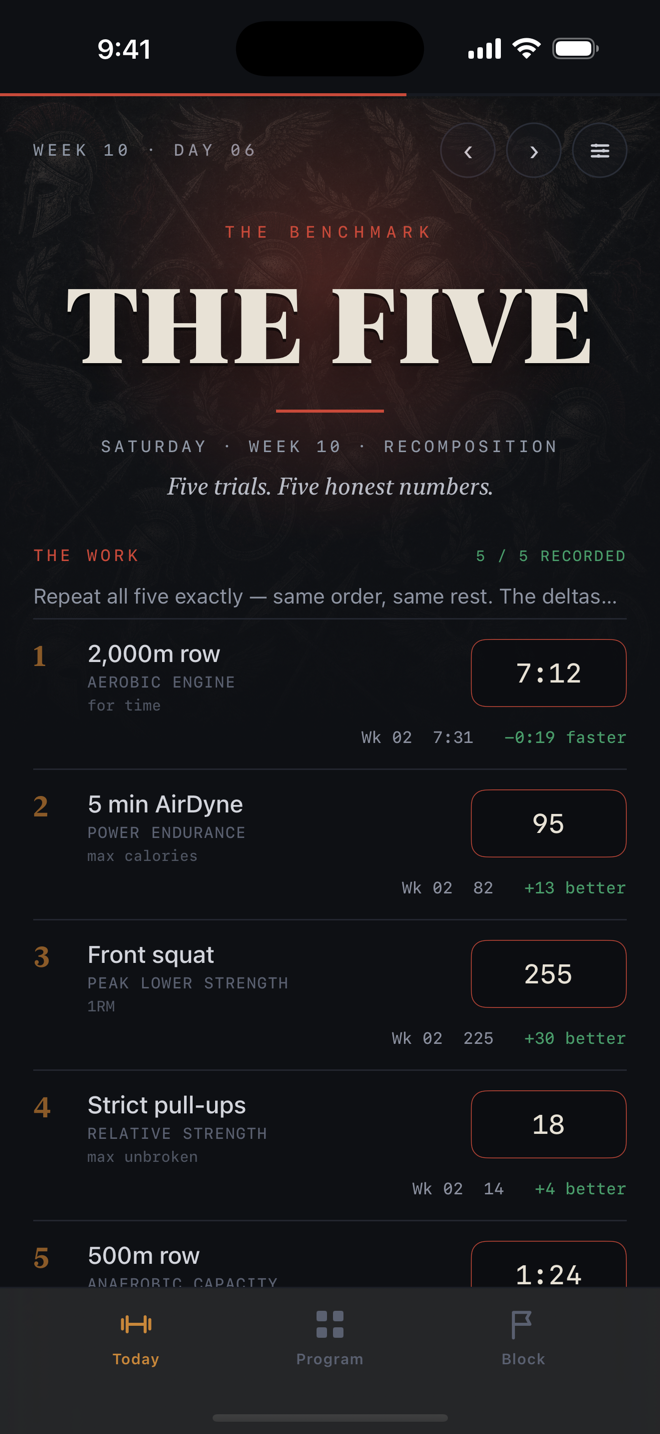
2,000m row Wk 02  7:31 Wk 10  7:12 −0:19 faster
Strict pull-ups Wk 02  14 Wk 10  18 +4 better
500m row Wk 02  1:29 Wk 10  1:31 +0:02 slower

A red delta isn't a failed program — it's information. Five tests exist precisely so one flat number can't hide what the other four gained.

A week-10 benchmark in the app, showing deltas against week 2
Test day

The first test exists to be beaten.

The Five is week 2's Saturday session. The only preparation it needs is showing up for the twelve days before it.